Cases

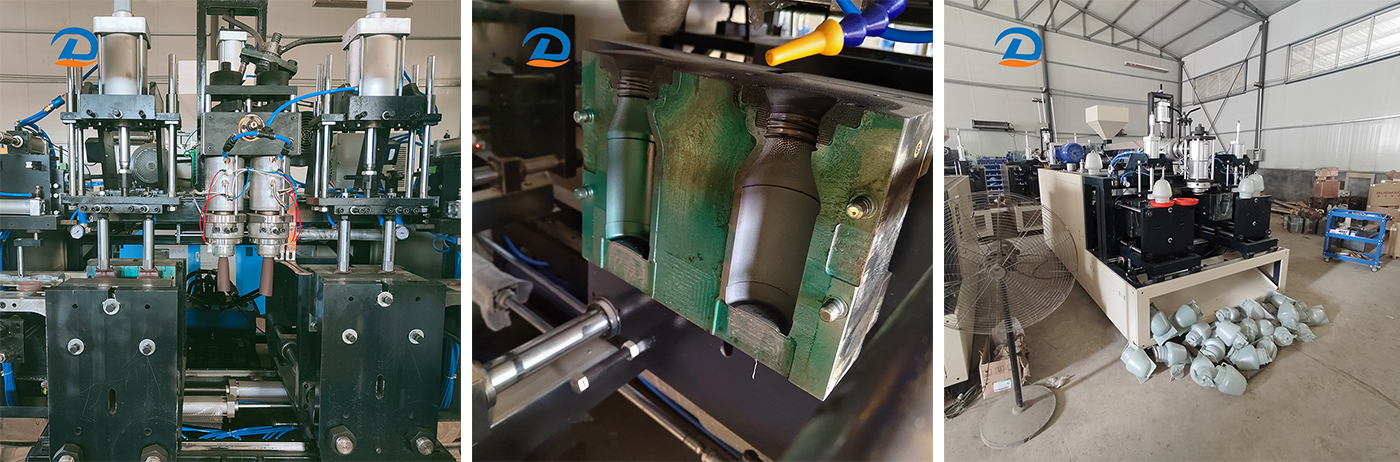
"One morning, our production line suddenly stopped," said the client’s operations manager. They are a mid-sized plastic bottle manufacturer, producing bottles for beverages, household cleaning, and personal care products. Their 2-Head HDPE Bottle Blow Molding Machine was having serious issues: some bottles had uneven wall thickness, necks were poorly sealed, and a few even leaked. The downtime delayed orders and caused significant stress.
After receiving their request, our engineering team immediately contacted the client and analyzed the situation via video calls and photos. We found two main problems: a slight misalignment in the screw extrusion system causing uneven melt flow, and worn mold parts combined with unstable temperature control, resulting in inconsistent bottle quality.
Step by step, we guided the client to realign the screws, recalibrate mold temperatures, adjust blow molding parameters, and replace worn parts. Our engineers monitored the process remotely in real time. Within 24 hours, the machine returned to stable operation, producing HDPE bottles with uniform wall thickness, perfect sealing, and smooth surfaces.
The client was thrilled: "Thanks to your guidance, not only is the machine back online, but production efficiency has improved and the defect rate has dropped. Our orders can now be delivered on time!"
This case highlights our fast response, professional technical support, and dedicated after-sales service. It demonstrates that our blow molding machines are more than equipment—they are part of a complete, reliable, and efficient production solution. We are committed to ensuring every 2-Head HDPE Bottle Blow Molding Machine and Plastic Bottle Production Line performs at its best.
Oct 08, 2026
How to Choose Blow Molding Machine Clamp Force for Your Container Size? For an extrusion blow molding machine, clamp force should be selected according to the container’s projected area, internal blowing pressure, mold design, material behavior, and safety margin—not simply the container volume. Learn More >Oct 08, 2026
Ultimate Guide to Bottle Blowing Machines for Beverage Production A bottle blowing machine turns plastic resin into the hollow containers that hold water, soft drinks, juice, and edible oil. Getting this machine right matters more than most first-time buyers expect, because it sets the ceiling for your entire line's throughput and fixes your unit cost for a decade or more. Learn More >Oct 05, 2026
What Should Operator Training Cover for an Automatic Blow Molding Machine? When I design automatic blow molding machine operator training, I cover more than machine buttons and production speed. A complete program must teach safety, machine anatomy, material handling, startup and shutdown procedures, parameter control, quality inspection, troubleshooting, preventive maintenance, changeover, emergency response, and documented qualification. Operators should understand Learn More >Oct 02, 2026
Mold Changeover on Automatic Blow Molding Machines: Steps Before Restarting Production I treat mold changeover as a controlled restart process, not simply a mold replacement task. Mold Changeover on Automatic Blow Molding Machines: Steps Before Restarting Production requires seven controls: isolate the machine, remove and install the mold, reconnect utilities, verify the recipe, complete a dry cycle, inspect trial parts, and approve stable production. This sequence protects Learn More >Oct 01, 2026
What Bottle Samples and Drawings Should You Provide Before a Machine Trial? Before arranging a machine trial, I recommend providing representative physical bottles, controlled technical drawings, closures, labels, production materials, target output, line-interface details, and written acceptance criteria. The supplier should receive enough information to evaluate bottle handling, filling, capping, labeling, orientation, transfer, and rejection performance under Learn More >Sep 24, 2026
How to Prepare Your Factory for Automatic Blow Molding Machine Installation Preparing a factory correctly reduces installation delays, rigging risks, commissioning problems, and unplanned production downtime. In this guide, I explain How to Prepare Your Factory for Automatic Blow Molding Machine Installation, from reviewing supplier drawings to completing utility tests, machine leveling, operator training, and production acceptance. The process applies to manufacturers Learn More >